Drawing on years spent working with archives and historical collections, I create handcrafted ceramics and illustrations inspired by folklore, decorative arts and overlooked histories for people who believe the objects we live with shape the way we remember and imagine the world around us.
Before becoming an artist, I spent nearly a decade following paper trails. Hidden among filing cabinets and cardboard boxes, history felt less distant. I spent years tracing the lives of women who had slipped from history and remained only in documents, pamphlets and ephemeral printed matter. To unfold a letter or turn the page of a newsletter is to repeat a gesture last performed by someone decades before. Unlike digital reproductions, physical collections create an embodied encounter with the past. They outlive their makers and wait patiently for another to continue telling the story.
It was this way of thinking that eventually led me to ceramics and illustration. If archives preserve the stories that came before us, perhaps new objects can carry something forwards. Clay, like paper, keeps a record of information and memory. Every carved line and painted indentation preserves the negotiation between hand and material. My creative practice has simply become another kind of archive, where forgotten superstitions and decorative traditions are gathered from the margins of history and given another life in objects that I hope will outlast me.
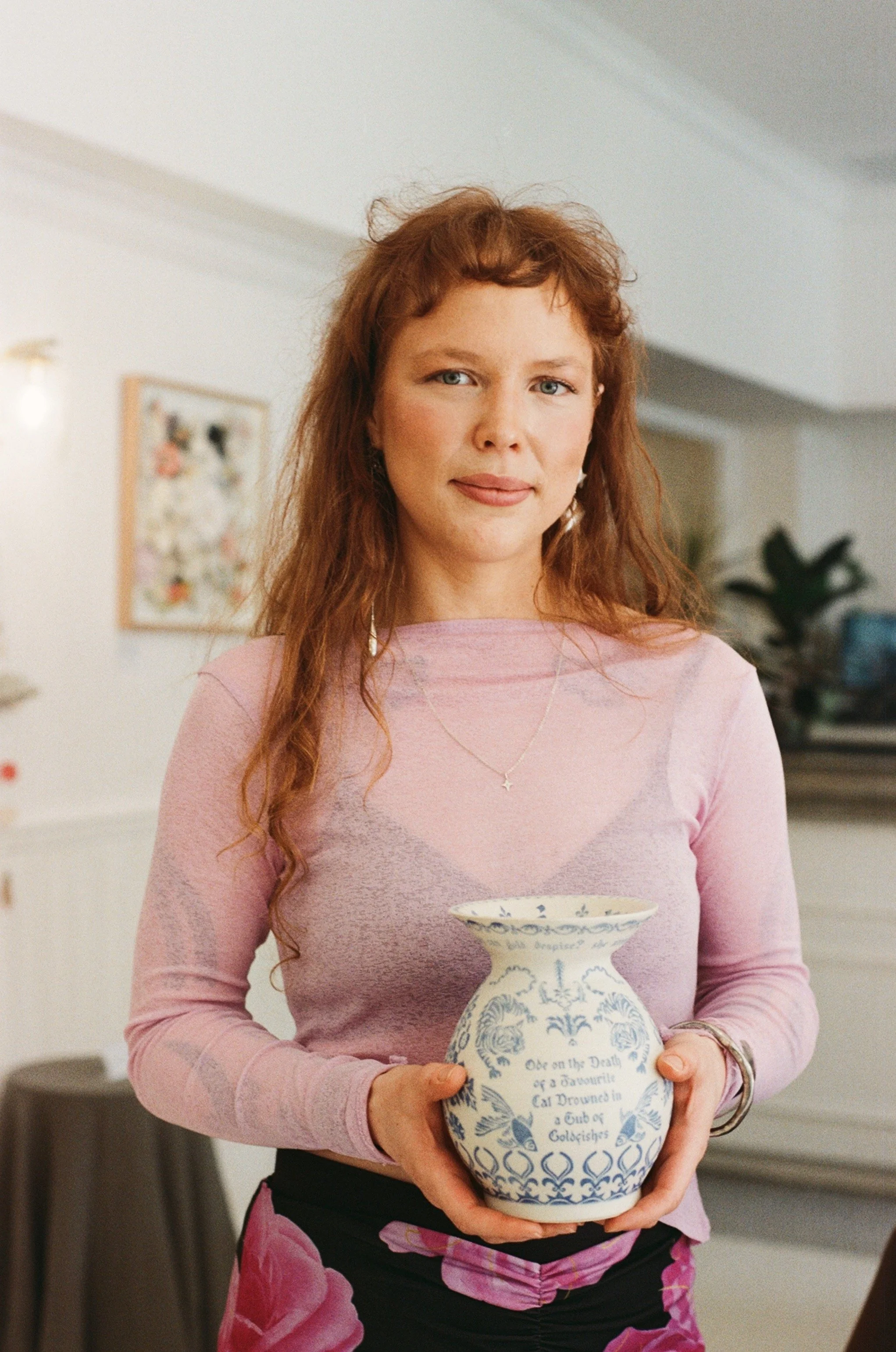
Biography
Bec Wonders (b. Sweden) is a ceramic artist, illustrator, and researcher whose practice explores the intersections of material culture, feminist historiography and visual language. Naturally interdisciplinary, her work celebrates the cross-pollination of archival research, women’s storytelling and European folk art.
Wonders earned a PhD in Feminist Print History from the Glasgow School of Art (2021) and has held a Research Associate position in the Faculty of History at the University of Oxford. She has taught and lectured at the Institute of Historical Research, the Cambridge School of Art, University College London, Tate Britain, Leipzig University and many others. Her research has been presented at international conferences including the Society for the History of Authorship, Reading and Publishing; the Women in Publishing Conference and Art Libraries Society.
Wonders has written several academic journal articles and book chapters (scroll down to CV for a full list). She is the founder of the independent feminist digital archive Frauenkultur and co-founder of the Vancouver Women’s Library. As an illustrator, she has produced commissioned work for UN Women, the Friedrich Ebert Stiftung and the European Network of Migrant Women.
Now based in London, Wonders continues to develop a research-led ceramic practice that integrates archival inquiry, humour, and feminist critique. She works multilingually in English, German, and Swedish.
Artist Statement
My practice explores material culture, folklore and historiography through painting and ceramics. Working primarily in watercolour and sgraffito carving, I draw on the flat graphic language of mimeograph printing, stencil-based illustration and folk art traditions to create narrative images that combine humour, warning and social commentary. I am particularly interested in how painted surfaces can function simultaneously as image, object and storytelling device.
Now based in London, following an upbringing across Northern Europe, I bring together different regional folk traditions, vernacular design histories and systems of symbolic imagery. My work is informed by traditions of narrative painting and decorative art, from Northern European woodcut illustration and British Arts and Crafts design to the political graphic languages of the Women in Print Movement. I am also influenced by the compressed symbolic storytelling of medieval painting, devotional objects and early modern moral imagery, particularly works where allegory, superstition and domestic instruction intersect.
Through archival research, I examine how images circulate across print, craft and domestic space, and how motifs shift meaning across generations. This emerges visually through layered washes, flattened perspective and repeated imagery. While rooted in historical research, my work engages contemporary fine art discourses through questions of materiality, reproduction, ornament and the relationship between design and craft traditions.
CV
-
PhD | 2021 | Glasgow School of Art
‘Please Say More’: mediating conflict through letter-writing in British second wave feminist periodicals, 1970-1990
Read Here
Supervised by Prof. Susannah Thompson, Dr. Marianne Greated, Dr. Deborah JacksonMPub | 2018 | Simon Fraser University
Counterpublics Revisited: a case study of the Vancouver Women’s Library
Supervised by Associate Professor Dr. John MaxwellBA | 2016 | University of British Columbia
Philosophy MajorBFA | 2015 | Emily Carr University of Art and Design
Visual Arts Major -
Love Your Enemy? Tracing the Transmission of Political Lesbianism from the US to the UK, 1970-80
Institute of Historical Research | Women’s History Seminar | 2024Keynote: The Women in Print Movement
ETCETERAS: Feminist Festival of Design and Publishing | 2023Dear Sister: Mediating Feminist Conflict Before the Internet
FUTURESS | Feminist Lecture Series | 2022
Watch hereComplicated Sisterhood: Negotiating Socialist Feminism in the Second Wave Periodicals Red Rag and Scarlet Women
University College London | Women’s Liberation SIG | 2021Networks of Conflict and Liberation: What Second Wave Feminist Periodicals Can Tell Us About Woman-Controlled Communication Infrastructures
University of Oxford | Women, Gender and Culture Seminar Series | 2021The Women in Print Movement: A Brief History of Feminist Publishers and Political Women’s Presses During the 1970s and 1980s
Glasgow School of Art | MLitt Art Writing | 2021Books, Periodicals and Women’s Archives: A Brief History of Second Wave Feminist Print Culture
Glasgow School of Art | Paint & Printmaking lecture series | 2021 -
Networks of Conflict and Mediation: Negotiating Socialist Feminism in the Second Wave Periodicals Red Rag and Scarlet Women
The Edinburgh Companion to Women in Publishing, 1900-2000 | In press‘Please Say More’: Mediating Conflict Through Letter-Writing in British Second Wave Feminist Periodicals, 1970-1990
PhD Thesis | Being prepared for publication | Read HereMapping Second Wave Feminist Periodicals: Networks of Conflict and Counterpublics, 1970–1990
Art Libraries Journal | 45(3), 106-113 | Read Here -
A Space to Debate Socialist Feminism: Mediating Conflict Through Serialised Letter-Writing in Second Wave Feminist Periodicals
Polytechnic of Turin, Italy | Communication, Capitalism and Critique: Critical Media Sociology in the 21st Century | 2022Women’s Webs: Second Wave Periodicals as Feminist Networks
University of Amsterdam | The Society for the History of Authorship, Reading and Publishing | 2022Feminist Publications in Movement: Developing a Model for a Feminist Publishing Circuit
The Society for the History of Authorship, Reading and Publishing | Munich | 2021
Roundtable with Gail Chester, Wangui Wa Goro and Magda OldziejewskaBehind the Veil: Mapping Feminist Periodicals, 1970-1990
University of Glasgow | Art Libraries Society 50th Anniversary Conference | 2019Dear Sisters: The Role of Letters in British Second Wave Feminist Periodicals
University of Reading | Women in Publishing Conference | 2019Unravelling Feminist Periodicals
Royal College of Art | National Association of Fine Art Education Conference | 2019 -
Counter Print: A Discussion About the Alternative Feminist Art Press
Tate Britain | Women in Revolt: Radical Acts, Contemporary Resonances | 2024Thinking Through the British Feminist Magazine Spare Rib
Cambridge School of Art | Fashion Communication and Branding BA | 2023Feminist Sci-Fi Drawing Workshop for East London Rape Crisis Centre
The Nia Project | Young Women & Girls Feminist Funday | 2022Difficult Sisterhood: Mediating Feminist Conflict Through Letter-Writing
Leipzig University | Feminism is a Battlefield | 2022Women’s History in Times of Crises
FiLiA Portsmouth | Conversation | 2021
• Co-presented with Dr. Natalya Vince
• Launch of co-produced podcast “Making Feminist History Visible: An International Conversation About Women’s Archives and Records” -
Frauenkultur Archive
Founder | 2020
Explore the archiveThe Vancouver Women’s Library
Co-founder | 2017 -
European Network of Migrant Women
Typeset and Design | Info Sheet on Sexual Exploitation | 2022UN Women
Head Illustrator | Youth Journey to Generation Equality Forum | 2020Friedrich Ebert Stiftung
Live Illustrator | Gender and Energy Seminar Series | 2020European Network of Migrant Women
Typeset and Design | Best Practice Principles of Assistance to Migrant Female Victims of Trafficking for Sexual Exploitation | 2020UN Global Compact
Live Illustrator | How Businesses Can support Women During Covid-19 in Africa | 2020